Missing teeth can affect more than your smile. They may make chewing difficult, change the way you speak and affect the alignment of your remaining teeth. Depending on the number and location of missing teeth, replacing them can help restore oral function, appearance and confidence.
Fortunately, there are several missing teeth replacement options to consider, including dental implants, dental bridges and dentures. Each option has different advantages, limitations, costs and maintenance requirements.
At Procare Dental Clinic in Banashankari, dental implants are among the restorative options available for patients with one or more missing teeth. Treatment planning depends on the patient’s oral health, bone support and individual requirements.
Procare Dental Clinic+1
In this guide, we explain how dental implants, bridges and dentures work, compare their differences and discuss how to choose an option that suits your needs.
Why Is It Important to Replace Missing Teeth?
A missing tooth may seem like a minor concern, especially if it is towards the back of the mouth and not easily visible. However, tooth loss can affect oral function and the health of surrounding structures.
Depending on the location and number of missing teeth, possible consequences include:
-
Difficulty chewing certain foods.
-
Changes in speech or pronunciation.
-
Shifting of neighbouring teeth into the gap.
-
Changes in the way your upper and lower teeth meet.
-
Bone loss in the area of a missing tooth.
-
Changes in smile appearance and confidence.
Not everyone experiences all these problems, and the effects vary according to individual circumstances. A dental examination can help determine whether replacement is recommended and which treatment may be appropriate.
If you are searching for dental treatment for missing teeth in Banashankari, your dentist can assess your oral health and explain the available restorative options.
1. Dental Implants: A Fixed Tooth Replacement Option
Dental implants are artificial tooth roots placed in the jawbone to support replacement teeth. They can be used to replace a single missing tooth, several teeth or a complete set of teeth, depending on the treatment plan.
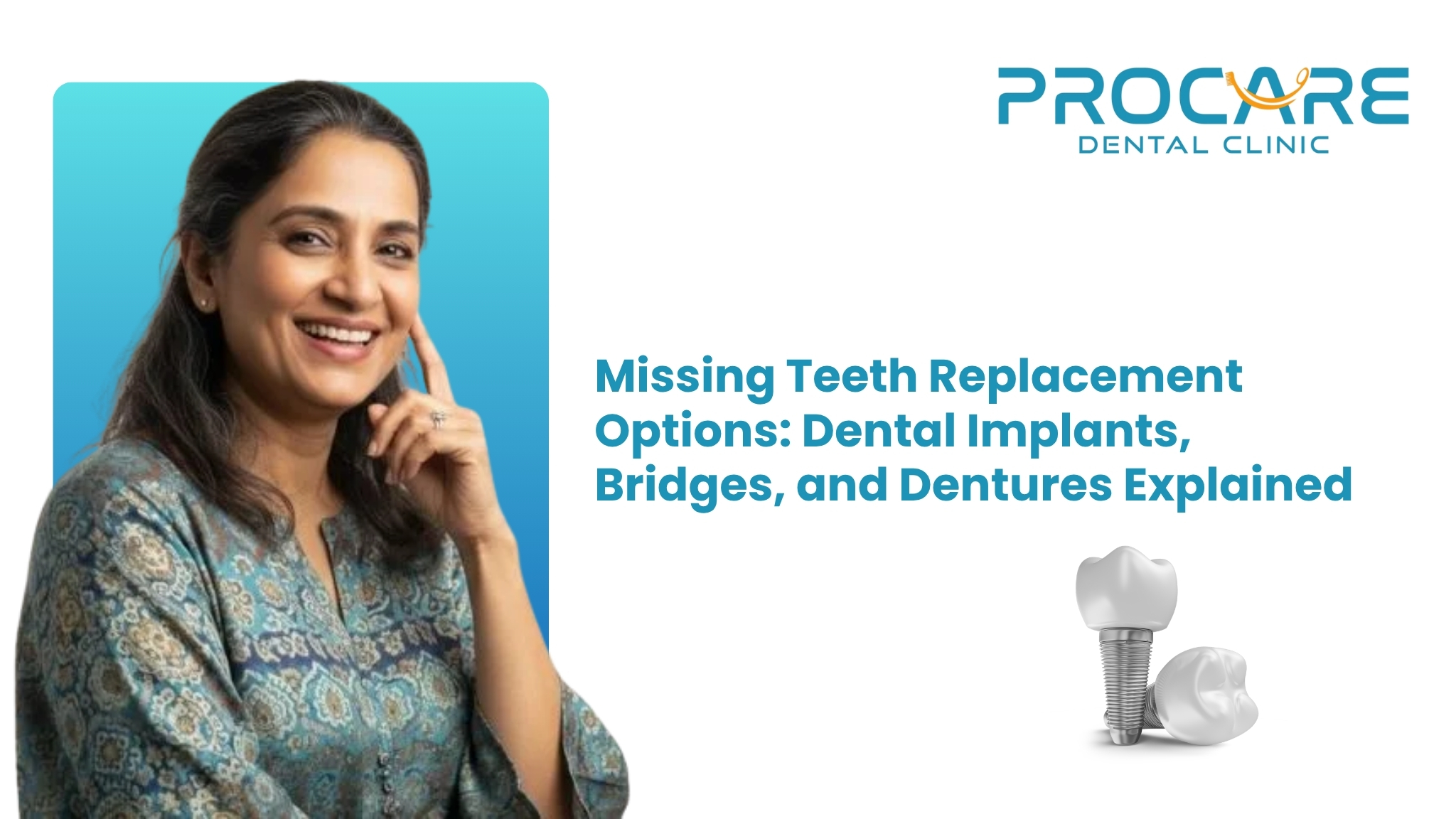
A typical implant restoration consists of three components:
-
Implant: A post, commonly made of titanium, placed in the jawbone.
-
Abutment: A connector that supports the replacement tooth.
-
Crown or prosthesis: The visible artificial tooth or set of teeth attached to the implant or implants.
After implant placement, a healing period is generally needed for the implant to integrate with the surrounding bone. The final restoration is then completed according to the treatment plan.
Benefits of Dental Implants
Independent support: A single implant usually does not require healthy neighbouring teeth to be reshaped to support the replacement tooth.
Natural-looking appearance: A custom-made crown can be designed to complement the colour and shape of your remaining teeth.
Chewing function: A properly restored implant can provide stable support for biting and chewing.
Support for jawbone health: An implant transfers chewing forces to the jawbone and can help maintain bone in the area, although it cannot prevent every type of bone loss.
Long-term use: Dental implants can last many years with appropriate oral hygiene, professional monitoring and maintenance. The crown or other restoration may need repair or replacement over time.
For suitable patients, dental implants in Banashankari may be an option for replacing one or multiple missing teeth. Procare Dental Clinic describes an implant treatment process that includes consultation, imaging, implant placement, healing and restoration.
Procare Dental Clinic+1
Who May Be Suitable for Dental Implants?
Implants may be considered for patients who have:
-
One or more missing teeth.
-
Adequate jawbone support or suitability for additional bone procedures.
-
Healthy gums or gum disease that has been appropriately managed.
-
General health that permits implant surgery and healing.
-
The ability to maintain good oral hygiene and attend follow-up appointments.
Certain medical conditions, medications, smoking habits and insufficient bone can affect treatment planning. A dentist needs to evaluate these factors before recommending an implant.
What Are the Limitations of Dental Implants?
Implant treatment involves surgery and usually takes longer than a traditional bridge or conventional denture. Additional procedures may be required in some cases, and the initial cost may be higher.
Implants also need ongoing care. Inflammation can develop around an implant if plaque accumulates, so careful cleaning and regular dental examinations remain important.
2. Dental Bridges: Replacing a Missing Tooth Using Nearby Teeth
A dental bridge is a fixed restoration that replaces a missing tooth by using supporting teeth or another suitable support arrangement.
In a traditional bridge, the teeth on either side of the gap are generally prepared to hold crowns. These crowns support an artificial tooth, known as a pontic, which fills the space.
Dental bridges can be useful when the neighbouring teeth are suitable to support the restoration. They may also be considered when the supporting teeth already need crowns because of existing damage or extensive restorations.
Benefits of Dental Bridges
Fixed restoration: A traditional bridge remains in place and does not need to be removed for everyday use.
Shorter treatment timeline: Bridges can often be completed more quickly than implant treatment because they do not require the same bone-healing period.
No implant surgery: A traditional bridge does not require an implant to be surgically placed in the jawbone.
Restores appearance and function: A well-designed bridge can fill the gap and improve chewing and smile appearance.
Limitations of Dental Bridges
A traditional bridge generally requires reshaping the supporting teeth, which involves removing some natural tooth structure. Those teeth may need maintenance or additional treatment in the future.
A bridge also does not replace the missing tooth root, so bone loss at the site of the missing tooth may continue.
Cleaning beneath the artificial tooth is important because food and plaque can accumulate in the area.
If you are exploring dental bridges for missing teeth, ask your dentist about the condition of the supporting teeth, the bridge design and the expected maintenance requirements.
3. Dentures: Removable Replacement Teeth
Dentures are artificial teeth designed to replace missing teeth. Depending on how many teeth are missing, a dentist may recommend partial dentures or complete dentures.
Partial Dentures
Partial dentures replace some missing teeth when natural teeth remain. They may use clasps or other components to help keep the denture in position.
They can be a suitable option for people who need to replace multiple teeth without undergoing implant surgery.
Complete Dentures
Complete dentures replace all the teeth in the upper jaw, lower jaw or both. They rest on the underlying oral tissues and are designed to restore appearance and basic chewing function.
Conventional dentures are removable, so they need to be taken out for cleaning and generally removed during sleep unless your dentist advises otherwise for a specific reason.
Benefits of Dentures
Replace multiple missing teeth: Partial and complete dentures can replace several teeth or an entire dental arch.
Non-surgical option: Conventional dentures do not require implant placement surgery.
Flexible treatment planning: They can be designed for different patterns of tooth loss.
Potentially lower initial cost: Conventional dentures may cost less initially than implant-based options, depending on the design and clinical requirements.
Limitations of Dentures
Removable dentures can move or feel less stable during eating and speaking, particularly if they do not fit properly. They may require adjustments, relining or replacement as the shape of the gums and jaw changes.
Some patients take time to adapt to wearing dentures and may need to modify their eating habits while adjusting.
For patients exploring denture treatment for missing teeth, a dental examination can help determine the appropriate denture design and whether additional treatment is needed to improve stability.
Dental Implants vs Bridges vs Dentures: What Is the Difference?
The following table summarises the main differences between these three tooth replacement options.
| Feature | Dental implants | Dental bridges | Removable dentures |
|---|---|---|---|
| How they work | Supported by implants placed in the jawbone | Usually supported by neighbouring teeth | Rest on the gums and remaining oral structures |
| Suitable for | One or multiple missing teeth, depending on the design | One or more missing teeth in suitable cases | Several missing teeth or complete tooth loss |
| Surgery | Usually requires implant surgery | Traditional bridges generally do not require implant surgery | Conventional dentures do not require implant surgery |
| Effect on nearby teeth | Usually does not require reshaping healthy adjacent teeth | Traditional bridges usually require preparation of supporting teeth | May rely on remaining teeth for support, depending on the design |
| Bone support | Can help maintain bone around the implant | Does not replace the missing root | Does not replace the missing root |
| Removable | Usually fixed, depending on the restoration | Fixed | Usually removable |
| Treatment time | Often several months, depending on healing | Often shorter than implant treatment | Varies with design and preparation |
| Maintenance | Brushing, interdental cleaning and professional monitoring | Cleaning around the supporting teeth and beneath the bridge | Daily removal and cleaning, with regular dental reviews |
There is no single solution that is best for every patient. The choice depends on the condition of your gums, available bone, number of missing teeth, health of remaining teeth, budget and personal preferences.
Which Missing Teeth Replacement Option Is Best for You?
The most suitable treatment depends on your individual dental condition. Here are some general considerations to discuss with your dentist.
If You Have One Missing Tooth
A single dental implant may be an option if the jawbone and gums are suitable. It can replace the missing tooth without usually requiring preparation of the neighbouring healthy teeth.
A traditional dental bridge may be an alternative if the neighbouring teeth are suitable to support it, particularly when they already need crowns.
Explore single tooth implant treatment in Banashankari to understand the assessment and treatment process.
If You Have Several Missing Teeth
Depending on the position of the gaps, your dentist may recommend multiple implants, an implant-supported bridge, a conventional bridge or a partial denture.
For example, several missing teeth next to each other may sometimes be replaced using a bridge supported by strategically placed implants rather than an individual implant for every tooth.
The best design depends on your bone support, bite and the number and location of the missing teeth.
If You Have Lost All Your Teeth
Complete dentures are one option for replacing all teeth in a dental arch. Some patients may also be suitable for implant-supported dentures or fixed implant-supported teeth.
Implant-supported solutions can provide additional stability, but they require surgical treatment and careful evaluation. Not everyone is suitable for every implant option.
If you have extensive tooth loss, ask about full-mouth dental implant treatment in Banashankari and whether removable or fixed restorations are appropriate for your needs.
If You Want to Avoid Surgery
Conventional bridges and removable dentures may be worth discussing if you prefer not to undergo implant surgery.
However, a bridge may involve preparation of neighbouring teeth, and a removable denture may feel different from natural teeth. Your dentist can explain the advantages and trade-offs of each option.
How Much Does Missing Teeth Replacement Cost?
The cost of replacing missing teeth varies according to the type of restoration, the number of teeth being replaced, materials, clinical complexity and any additional treatment required.
In general, the total treatment cost may be influenced by:
-
The number and location of missing teeth.
-
Whether you need a single tooth or a full arch replaced.
-
The type and material of the restoration.
-
The condition of your gums and remaining teeth.
-
Whether bone grafting or other preparatory procedures are necessary.
-
The number of appointments and follow-up requirements.
Dental implants may have a higher initial cost because treatment involves implant placement, healing and the final restoration. A bridge or conventional denture may have a lower initial cost in some cases, but future maintenance and replacement costs should also be considered.
If you are comparing dental implant treatment costs in Banashankari, ask for a personalised estimate that explains what is included in the treatment plan. The clinic can confirm current prices during consultation.
How to Care for Your Replacement Teeth
Whichever option you choose, regular oral hygiene and professional follow-up help protect your remaining teeth, gums and restorations.
Caring for Dental Implants
-
Brush twice daily with fluoride toothpaste.
-
Clean around the implant crown and gumline.
-
Use floss or interdental brushes as recommended by your dentist.
-
Attend regular dental examinations.
-
Contact your dentist if you notice swelling, bleeding or movement of the restoration.
Caring for Dental Bridges
-
Brush around the bridge and supporting teeth.
-
Clean underneath the artificial tooth with suitable cleaning aids.
-
Avoid using the bridge to bite extremely hard objects.
-
Attend routine appointments to check the supporting teeth and gums.
Caring for Dentures
-
Remove and clean conventional dentures daily.
-
Clean your gums, tongue and any remaining natural teeth.
-
Follow your dentist’s instructions for overnight denture use.
-
Avoid hot water that could distort the denture.
-
Arrange adjustments if the denture causes sores or becomes loose.
Good maintenance can help improve comfort and extend the useful life of your replacement teeth.
Why Consider Procare Dental Clinic in Banashankari?
Choosing a dental clinic for missing teeth replacement involves more than selecting a particular treatment. It is important to receive a thorough examination, understand the available options and have a treatment plan suited to your oral health.
Procare Dental Clinic offers dental implants in Banashankari, including implant treatment for single and multiple missing teeth. Its published process includes consultation, digital imaging, implant placement, healing and restoration.
Procare Dental Clinic+1
The clinic also provides a range of general and restorative dental services, allowing patients to discuss their broader dental needs.
ProCare Dental Clinic+1
Clinic details
Procare Dental Clinic – Banashankari
Address: 124, Banashankari 3rd Stage, 3rd Phase, 5th Block, Dr. Puneet Rajkumar Road, Bengaluru, Karnataka – 560085
Phone: +91 88671 86767
Website: https://procaredentalbanashankari.com/
Contact the clinic to confirm appointment availability and request an assessment for your missing teeth.
Frequently Asked Questions
1. What are the main options for replacing missing teeth?
The main options include dental implants, dental bridges and removable dentures. The most suitable treatment depends on the number of missing teeth, the health of your gums and remaining teeth, bone support and personal preferences.
2. Are dental implants better than bridges?
Dental implants can replace missing teeth without usually requiring healthy neighbouring teeth to be reshaped. Bridges may be suitable when nearby teeth can support the restoration, especially if they already need crowns. Your dentist can compare the options for your specific situation.
3. Are dentures suitable for replacing several missing teeth?
Yes. Partial dentures can replace several missing teeth when natural teeth remain, while complete dentures can replace all teeth in an arch. Fit, comfort and stability depend on the design and the shape of the supporting tissues.
4. Can dental implants replace all missing teeth?
Implant-supported restorations can replace an entire dental arch in suitable patients. Depending on the treatment plan, implants may support a removable denture or a fixed restoration. A clinical examination is needed to determine eligibility.
5. How long does missing teeth replacement take?
The timeline varies by treatment. Conventional bridges and dentures can often be completed more quickly than implant treatment. Implants usually require a healing period, and additional procedures may extend the overall timeline.
6. What happens if I do not replace a missing tooth?
Depending on the location and number of missing teeth, you may experience difficulty chewing, changes in speech, shifting teeth or bone changes at the missing tooth site. Your dentist can assess whether replacement is recommended for your situation.
7. Which missing teeth replacement option is most affordable?
Conventional dentures and some dental bridges may have lower initial costs than implants. However, prices vary, and long-term maintenance should also be considered. Request an individual treatment estimate before making a decision.
8. Where can I get missing teeth replacement in Banashankari?
Procare Dental Clinic offers dental implant treatment and other dental services in Banashankari, Bengaluru. Visit the official dental implants page or contact the clinic to arrange a consultation.
Conclusion
Missing teeth can affect chewing, speech, appearance and oral health, but several replacement options are available. Dental implants, dental bridges and dentures each have different benefits and limitations.
Dental implants may be suitable for patients seeking an independently supported replacement. Bridges can provide a fixed solution when neighbouring teeth are suitable to support them, while dentures can replace several or all missing teeth without requiring implant surgery.
The right treatment depends on your individual dental condition, budget, preferences and long-term goals. If you are exploring missing teeth replacement options in Banashankari, consult Procare Dental Clinic for an examination and personalised treatment plan.