
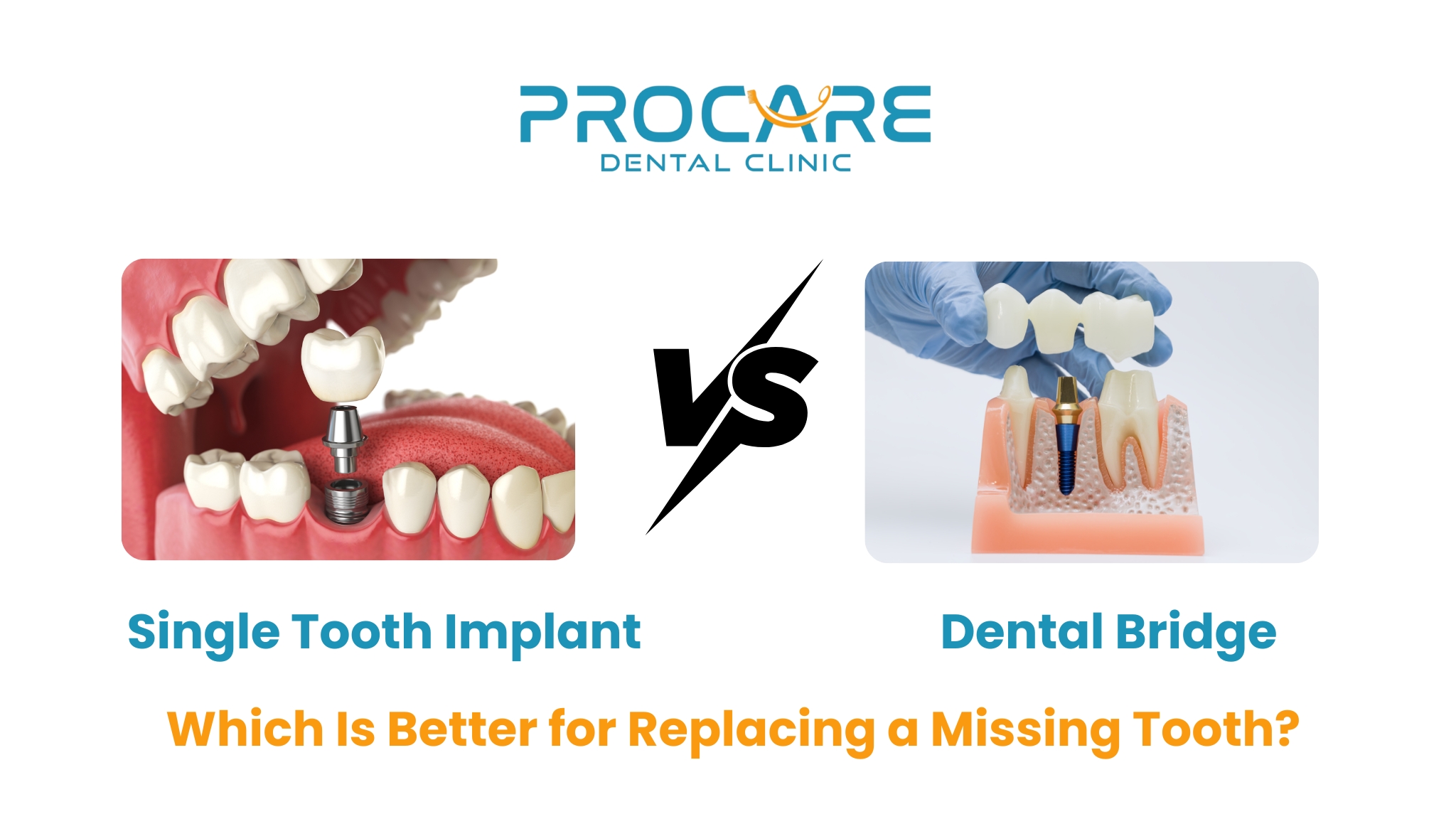
Losing a single tooth can affect more than your smile. Depending on its location, a missing tooth may make chewing less comfortable, affect speech and allow neighbouring teeth to shift over time. Replacing it can help restore your bite, appearance and everyday oral function.
Two common options are a single tooth dental implant and a dental bridge. Both can replace a missing tooth, but they differ in how they are supported, the treatment process, maintenance requirements and long-term considerations.
If you are exploring dental implants in Banashankari, Procare Dental Clinic offers implant treatment with individual assessment and treatment planning. The clinic’s website also provides information about replacing missing teeth and the dental implant process.
Procare Dental Clinic+1
In this guide, we compare a single tooth implant and a dental bridge to help you understand their differences and prepare for an informed discussion with your dentist.
What Is a Single Tooth Dental Implant?
A single tooth implant is a replacement option that uses an implant placed in the jawbone to support an artificial tooth.
The treatment generally involves three main components:
-
Dental implant: A small post, commonly made from titanium, that is placed in the jawbone and serves as an artificial tooth root.
-
Abutment: A connector attached to the implant.
-
Dental crown: The visible replacement tooth designed to restore the appearance and function of the missing tooth.
After implant placement, a healing period is usually needed for the implant to integrate with the surrounding bone. The dentist then completes the restoration according to the treatment plan.
A single tooth implant in Banashankari may be suitable when a patient has sufficient bone support, healthy or adequately treated gums, and general health that permits implant treatment. A dental examination and appropriate imaging help determine eligibility.
Procare Dental Clinic+1
What Is a Dental Bridge?
A dental bridge replaces a missing tooth by supporting an artificial tooth between neighbouring teeth or by using another suitable supporting arrangement.
In a traditional dental bridge, the teeth on either side of the gap are usually prepared to support crowns that hold the replacement tooth, called a pontic, in place.
A bridge can provide a fixed replacement without requiring an implant to be placed in the jawbone. However, the suitability of this option depends on the condition, position and strength of the supporting teeth.
A dentist may discuss a dental bridge for a missing tooth as an alternative to implant treatment, particularly when neighbouring teeth already need crowns or when implant surgery is unsuitable.
The exact bridge design depends on the clinical situation. Your dentist should explain how much preparation is needed and which teeth will support the restoration.
Single Tooth Implant vs Dental Bridge: Key Differences
| Feature | Single tooth implant | Traditional dental bridge |
|---|---|---|
| Support | Supported by an implant in the jawbone | Usually supported by neighbouring teeth |
| Effect on adjacent teeth | Typically does not require preparation of neighbouring healthy teeth | Usually requires preparation of the supporting teeth |
| Surgery | Requires implant placement surgery | Usually does not require implant surgery |
| Treatment time | Often takes several months, depending on healing and complexity | Often completed more quickly, depending on the case |
| Bone support | Transfers chewing forces through the implant and helps maintain bone in the area | Does not replace the tooth root, so bone loss at the missing tooth site may continue |
| Cleaning | Requires careful cleaning around the crown and gumline, including between teeth | Requires cleaning around the bridge and underneath the replacement tooth |
| Longevity | Can last many years with appropriate care; the crown may need replacement | Can last many years, but may require repair or replacement |
| Best suited for | Suitable patients who want an independently supported replacement | Patients with suitable supporting teeth, especially when those teeth also need restoration |
Neither option is best for everyone. The right choice depends on your oral health, bone condition, the neighbouring teeth, your medical history, budget and preferences.
1. Which Option Looks and Feels More Like a Natural Tooth?
Both dental implants and bridges can be designed to match the colour, shape and size of your natural teeth.
A single tooth implant is anchored in the jawbone, providing support that is independent of the neighbouring teeth. Once restored and healed, it can feel and function much like a natural tooth.
A dental bridge can also provide a natural-looking fixed replacement. Its appearance and stability depend on the bridge design, the condition of the supporting teeth and the quality of the restoration.
For patients considering natural-looking dental implants in Banashankari, the dentist evaluates the missing tooth’s location, gum condition, bite and available bone before planning the restoration.
Which is better? Both options can produce pleasing results. An implant offers independent support, while a bridge may be a practical alternative when the neighbouring teeth can reliably support it.
2. Which Option Is Better for Preserving Healthy Teeth?
One of the biggest differences between an implant and a traditional bridge is how the replacement tooth is supported.
Single tooth implant
An implant usually does not require the neighbouring healthy teeth to be reshaped. This can be an important advantage when the teeth beside the gap are healthy and do not need crowns.
Dental bridge
A traditional bridge usually requires the supporting teeth to be prepared so that crowns can hold the artificial tooth in place. This means some natural tooth structure is removed, and the supporting teeth may require maintenance or further treatment in the future.
For someone with healthy neighbouring teeth, a single tooth dental implant may offer the advantage of preserving those teeth.
However, if the neighbouring teeth already have extensive fillings, damage or a need for crowns, a bridge may be a reasonable choice. Your dentist can compare the long-term implications of both options.
3. Which Option Helps Maintain Jawbone Health?
After a tooth is lost, the jawbone in that area may gradually shrink because it no longer receives the same stimulation from the missing tooth root.
A dental implant transfers chewing forces to the jawbone and can help maintain bone in the area around the implant. However, it cannot guarantee that all bone changes will be prevented.
A traditional dental bridge replaces the visible tooth but does not replace the missing root. Consequently, bone loss at the site of the missing tooth may continue.
This difference can be important when planning dental implant treatment in Banashankari. Your dentist may recommend an examination and imaging to assess the available bone and determine whether additional procedures are needed.
If bone support is insufficient, implant treatment may still be possible in selected cases, sometimes with additional procedures such as bone grafting.
4. Which Treatment Is Faster?
Treatment time is another important factor when choosing between an implant and a bridge.
Dental bridge treatment
A traditional bridge is often completed in fewer visits than an implant. The dentist prepares the supporting teeth, takes impressions or digital scans, and arranges for the bridge to be fitted. The timeline depends on the complexity of the case and the laboratory process.
Single tooth implant treatment
Implant treatment involves surgical placement followed by a healing period. The implant must integrate with the jawbone before the final restoration can be completed, although the timing and sequence vary according to the clinical situation.
Some patients may qualify for a temporary tooth during healing, but immediate placement or loading is not suitable for everyone.
If you need to replace a missing tooth quickly, discuss the expected timeline for both options with your dentist. The fastest treatment is not necessarily the most suitable long-term solution.
5. Which Option Is More Affordable?
The cost of replacing a missing tooth depends on the treatment plan, materials, clinical complexity and any additional procedures required.
A traditional dental bridge may have a lower initial cost than a single tooth implant in some cases. However, the total long-term cost depends on how well the restoration performs and whether it requires maintenance, repair or replacement.
The cost of a single tooth implant may include consultation, imaging, implant placement, the abutment, the crown and any additional procedures that are clinically necessary.
When comparing dental implants in Banashankari with a bridge, ask your dentist for a treatment estimate that clearly explains what is included.
Rather than choosing based on the initial price alone, consider the condition of the surrounding teeth, treatment duration, maintenance requirements and expected longevity.
6. How Long Do Dental Implants and Bridges Last?
Both options can provide long-term tooth replacement, but neither is guaranteed to last forever.
Dental implants can remain functional for many years with appropriate oral hygiene, healthy gums and regular professional monitoring. The crown attached to an implant may wear out, chip or require replacement even if the implant itself remains stable.
Dental bridges can also last many years. Their longevity depends on factors such as oral hygiene, bite forces, the condition of the supporting teeth and the health of the surrounding gums.
For either treatment, brushing twice daily, cleaning between teeth, avoiding damaging habits and attending regular dental examinations are essential.
Procare Dental’s guide to dental implant treatment and aftercare explains the importance of treatment planning, healing and follow-up care.
Procare Dental Clinic
7. Which Option Is Easier to Maintain?
Both implants and bridges require consistent daily cleaning. Neither should be treated as maintenance-free.
Caring for a dental implant
-
Brush twice daily with fluoride toothpaste.
-
Clean around the implant crown and gumline carefully.
-
Use floss or an interdental cleaning aid recommended by your dentist.
-
Attend regular check-ups to monitor the implant and surrounding gums.
-
Avoid smoking and seek advice if you notice bleeding, swelling or discomfort.
Caring for a dental bridge
-
Brush twice daily, including around the supporting crowns.
-
Clean beneath the artificial tooth using suitable floss threaders or interdental aids.
-
Pay attention to the gums around the supporting teeth.
-
Attend regular examinations to check the bridge and the teeth holding it in place.
A bridge can require extra attention beneath the replacement tooth because food and plaque may collect there. An implant also needs careful cleaning because inflammation around the implant can affect the surrounding tissues.
Your dentist can demonstrate the correct cleaning technique for whichever restoration you choose.
8. Who Is a Suitable Candidate for a Single Tooth Implant?
A single tooth implant may be considered if you:
-
Have one missing tooth that needs replacement.
-
Have adequate jawbone support or may be suitable for additional bone procedures.
-
Have healthy gums or have had existing gum disease appropriately managed.
-
Can maintain good oral hygiene.
-
Have general health and healing capacity suitable for implant surgery.
-
Prefer a replacement that does not usually depend on neighbouring teeth for support.
Certain conditions, medications, smoking habits and poorly controlled medical problems can affect implant planning or healing. These factors do not automatically rule out treatment, but they should be discussed during the consultation.
At Procare Dental Clinic in Banashankari, implant treatment planning includes evaluating the oral condition and using imaging to assess bone and plan placement.
Procare Dental Clinic
9. When Might a Dental Bridge Be the Better Choice?
A dental bridge may be worth considering if:
-
You prefer to avoid implant surgery.
-
The neighbouring teeth already need crowns or substantial restoration.
-
Your jawbone condition makes implant placement difficult and additional procedures are not suitable or preferred.
-
Your medical circumstances make surgery less appropriate.
-
You want a fixed replacement that may be completed in a shorter timeframe.
A bridge is not automatically the better choice for every patient who cannot or does not want an implant. Your dentist may discuss other options, including a removable partial denture, depending on your situation.
A clinical assessment is important because the supporting teeth must be strong enough to withstand the forces placed on the bridge.
10. What Happens During a Dental Implant Consultation?
If you are considering an implant to replace a missing tooth, the first step is a dental examination.
Your dentist may:
-
Examine the missing tooth area and the condition of the neighbouring teeth.
-
Check your gum health and bite.
-
Review your medical history, medications and oral hygiene habits.
-
Take dental X-rays or digital scans when indicated.
-
Assess jawbone support and whether additional procedures may be required.
-
Explain the implant and bridge options, including expected timelines, costs, benefits and risks.
Procare Dental Clinic describes a treatment process involving consultation and 3D imaging, implant placement, healing and integration, and final crown placement.
Procare Dental Clinic
If you are exploring single tooth implant treatment in Banashankari, ask your dentist to explain the likely treatment sequence and whether an implant or bridge better suits your oral health.
Why Consider Procare Dental Clinic for Missing Tooth Replacement?
Replacing a missing tooth requires careful planning to restore function while considering the health of the surrounding teeth and gums.
Procare Dental Clinic in Banashankari offers dental implant treatment as part of its restorative dental services. Its published treatment information discusses consultation, imaging, implant placement, healing and crown restoration.
Procare Dental Clinic+1
If you are comparing a dental implant in Banashankari with a bridge, contact the clinic to enquire about an assessment and the options available for your particular case.
Clinic details
Procare Dental Clinic – Banashankari
Address: 124, Banashankari 3rd Stage, 3rd Phase, 5th Block, Dr. Puneet Rajkumar Road, Bengaluru, Karnataka – 560085
Phone: +91 88671 86767
Website: https://procaredentalbanashankari.com/
Contact the clinic to confirm appointment availability and request a personalised treatment estimate.
Frequently Asked Questions
1. Is a single tooth implant better than a dental bridge?
A single tooth implant can be advantageous when you want independent support and wish to avoid preparing healthy neighbouring teeth. A bridge may be suitable when neighbouring teeth already need crowns or implant surgery is not appropriate. The best choice depends on your oral health and treatment goals.
2. Does a dental implant look like a natural tooth?
A properly planned implant crown can be designed to match the appearance of nearby teeth. The final result depends on factors such as gum health, tooth position, available bone and the design of the restoration.
3. Is a dental bridge faster than an implant?
A traditional dental bridge is often completed sooner because it does not require the bone-integration period associated with implant treatment. The exact timeline depends on the clinical situation and the restoration required.
4. Does a dental implant prevent jawbone loss?
An implant can help maintain bone in the area by transmitting chewing forces to the jawbone. However, it does not guarantee that all bone loss will be prevented.
5. Can I get a dental implant if I have bone loss?
Possibly. Some patients with insufficient bone may be candidates for additional procedures such as bone grafting, while others may need alternative treatments. A dental examination and appropriate imaging are necessary to determine suitability.
6. Which option is cheaper: a dental implant or a bridge?
A bridge may cost less initially in some cases, but the cost depends on the materials, supporting teeth, additional procedures and future maintenance. Request a personalised estimate for both options before deciding.
7. How do I clean a dental bridge or implant?
Both require twice-daily brushing, daily cleaning between teeth and regular professional check-ups. Bridges need careful cleaning beneath the artificial tooth, while implants require cleaning around the implant crown and gumline.
8. Where can I get a single tooth implant in Banashankari?
Procare Dental Clinic offers dental implant treatment in Banashankari. Visit the official dental implant service page to learn more and contact the clinic for an assessment.
Conclusion
Choosing between a single tooth implant and a dental bridge depends on more than appearance or initial cost. Both can replace a missing tooth and restore everyday function, but they differ in how they are supported, their treatment timelines and their effects on the surrounding teeth and bone.
A single tooth implant may be a good option when you want independent support and suitable bone and gum conditions. A dental bridge may be appropriate when neighbouring teeth can support it, particularly if those teeth already require restoration or you prefer to avoid implant surgery.
If you are considering dental implants in Banashankari, consult a dentist to compare the options based on your oral health, treatment goals, budget and long-term maintenance needs. A personalised treatment plan can help you make an informed decision about replacing your missing tooth.